Mbeki and After by Daryl Glaser
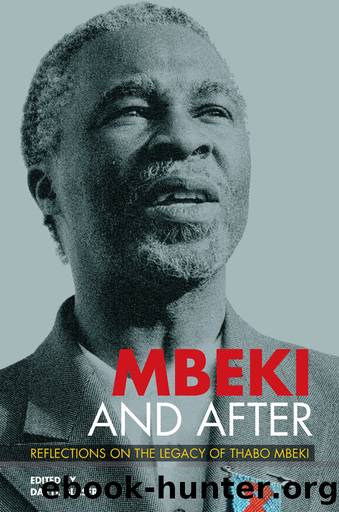
Author:Daryl Glaser [Glaser, Daryl]
Language: eng
Format: epub
ISBN: 9781776141449
Barnesnoble:
Publisher: Wits University Press
Published: 2010-10-01T00:00:00+00:00
fought for the democratisation of the state, and in so doing applied himself both to the relation between the different elements of the state itself (law, parliament and the executive or bureaucracy) and to the relation between the state and society. He was in favour of maximum possible power for the representative element and the minimum for the bureaucratic; the independence of the judiciary from the executive but not from Parliament ⦠He did not see the ârule of lawâ as a mere hangover [from bourgeois democracy] but as a crucial inhibition on bureaucracy and as a crucial guarantor of individual liberty [emphasis added].
The ideas that Fine attributes to Marx remain instructive, despite the many changes in the form of the modern state and law that have taken place in the intervening century-and-a-half. In fact, the growth of inequality globally and the long drawn-out life of capitalism (which does not look as if it will come to an end in the foreseeable future) have made engagement with the state even more necessary and, where possible, its oversight and governance by the poor majority essential.
Ironically, as the humanitarian organisation Médecins Sans Frontières pointed out in a publication (Bouchet-Saulnier 2007: xx), the growing acceptance of universal human rights has reinforced the need for the state because human rights are âclosely linked to notions of nationality and citizenship. Thus, without a state to protect freedoms and rights and take responsibility for providing its weakest members with social supports, the notion of âhuman rightsâ is more vulnerable than ever.â12
In keeping with these ideas TAC engaged continuously with politicians and government officials during Mbekiâs rule. When necessary it used the courts to advance its claims. In 2001, when TAC first announced that it had filed papers in the Pretoria High Court thereby commencing litigation against the Minister of Health, this was understood by many to be a step too far against the ANC. It caused profound unease at both ends of the spectrum of TACâs allies. Within Cosatu some saw it as an attack on the ANC. On the left it was regarded as short-circuiting the struggle and as reformism that would not deliver any benefits.
However, since then, albeit in an uncoordinated fashion, a growing number of pro-poor organisations have used the Constitution and, when necessary, the courts, to secure pro-poor reforms on AIDS, access to housing, womenâs rights, access to water, access to information and other issues.13
Whither pro-poor civil societyâs struggle for social justice?
This chapter has shown how pro-poor civil society redeveloped partly in reaction to Mbeki-ist denial. But in future it will need to be more than oppositional.
Under Mbeki new progressive civil society organisations such as TAC showed a dependence on the âoldâ liberation-struggle formations of civil society, particularly Cosatu. In future they will need to exert more influence on them.
Further, although many pro-poor civil society movements conducted ostensibly political campaigns there was an absence of a politics of civil society; a hole existed where there should have been a coherent analysis of the society in which we are living.
Download
This site does not store any files on its server. We only index and link to content provided by other sites. Please contact the content providers to delete copyright contents if any and email us, we'll remove relevant links or contents immediately.
Spell It Out by David Crystal(36221)
Life for Me Ain't Been No Crystal Stair by Susan Sheehan(35895)
The Great Music City by Andrea Baker(33427)
Cecilia; Or, Memoirs of an Heiress — Volume 1 by Fanny Burney(32712)
Cecilia; Or, Memoirs of an Heiress — Volume 2 by Fanny Burney(32075)
Cecilia; Or, Memoirs of an Heiress — Volume 3 by Fanny Burney(32058)
Professional Troublemaker by Luvvie Ajayi Jones(29744)
The Secret History by Donna Tartt(19443)
We're Going to Need More Wine by Gabrielle Union(19162)
Twilight of the Idols With the Antichrist and Ecce Homo by Friedrich Nietzsche(18761)
All the Missing Girls by Megan Miranda(16646)
Cat's cradle by Kurt Vonnegut(15538)
For the Love of Europe by Rick Steves(14863)
Pimp by Iceberg Slim(14778)
Bombshells: Glamour Girls of a Lifetime by Sullivan Steve(14210)
Norse Mythology by Gaiman Neil(13555)
Talking to Strangers by Malcolm Gladwell(13521)
Fifty Shades Freed by E L James(13340)
The Social Justice Warrior Handbook by Lisa De Pasquale(12286)
